
Bournemouth’s story begins with its transformation from heathland into a thriving Victorian seaside resort, a journey that forms the fascinating history of Bournemouth. Founded in the early 19th century, the town’s growth accelerated with the arrival of the railway, expansion of local government, and the establishment of key landmarks. This page covers Bournemouth’s origins, Victorian era development, 20th-century changes, and its modern status.
Origins and Early Settlement in the History of Bournemouth
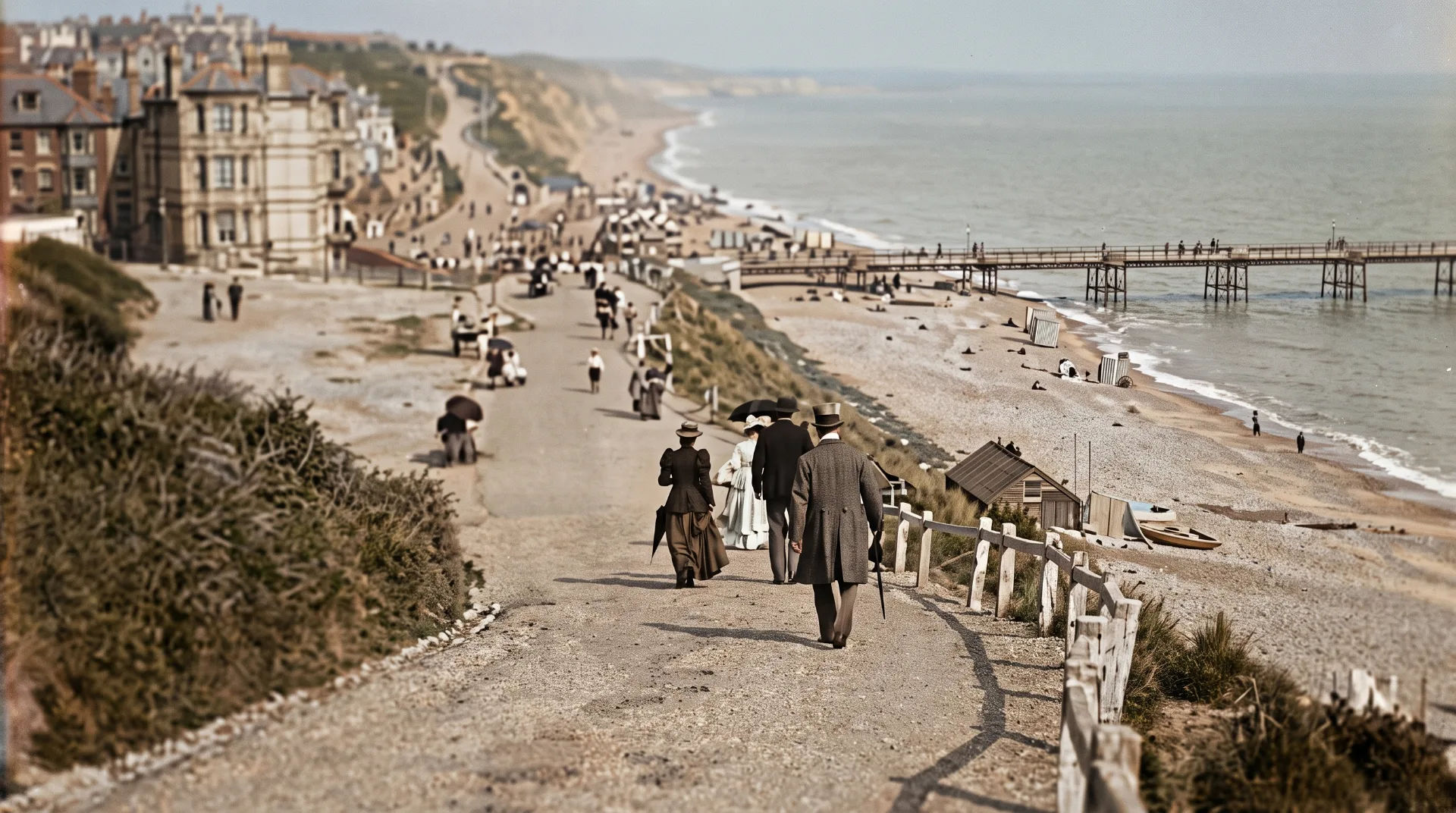
Before the 19th century, the area now known as Bournemouth was open heathland used for grazing cattle. The first recorded inhabitant is Lewis Tregonwell, who in 1810 visited the beach with his wife. Impressed by the location, he purchased 8½ acres and built a house along with cottages for his staff. Over time, Tregonwell acquired more land, and local landowners planted pine trees on the heath to improve the landscape.
Despite these early developments, Bournemouth remained without a formal settlement until the late 1830s. The rise in popularity of seaside resorts among the wealthy and middle classes in the late 18th and early 19th centuries set the stage for Bournemouth’s transformation. Resorts such as Brighton and Eastbourne were already established, and in 1836 Sir George Tapps-Gervis sought to create a similar destination at Bournemouth.
Tapps-Gervis commissioned Christchurch architect Benjamin Ferrey to design the new resort. Villas were constructed for summer visitors, marking the beginning of Bournemouth as a holiday destination. By 1840, a small village had formed, with stagecoaches stopping there en route between Southampton and Weymouth. That year also saw the publication of Bournemouth’s first guidebook, signalling its emerging status. This early chapter is a key part of the history of Bournemouth, showing its roots as a healthful retreat.
Victorian Growth and Infrastructure Development in Bournemouth’s History
The Victorian era sees Bournemouth’s rapid expansion. By 1851, the population reaches 695, and the first shops open on Commercial Road. Ten years later, the population nearly triples to 1,707. Local governance begins in 1856 with the establishment of a police force and an improvement commission responsible for street paving, cleaning, lighting, and drainage.
Key infrastructure milestones include the introduction of gas street lighting in 1864 and a piped water supply in 1866. A volunteer fire brigade forms in 1870, and by 1890 the town is governed by a mayor and aldermen rather than commissioners. These developments support the growing community and visitor numbers.
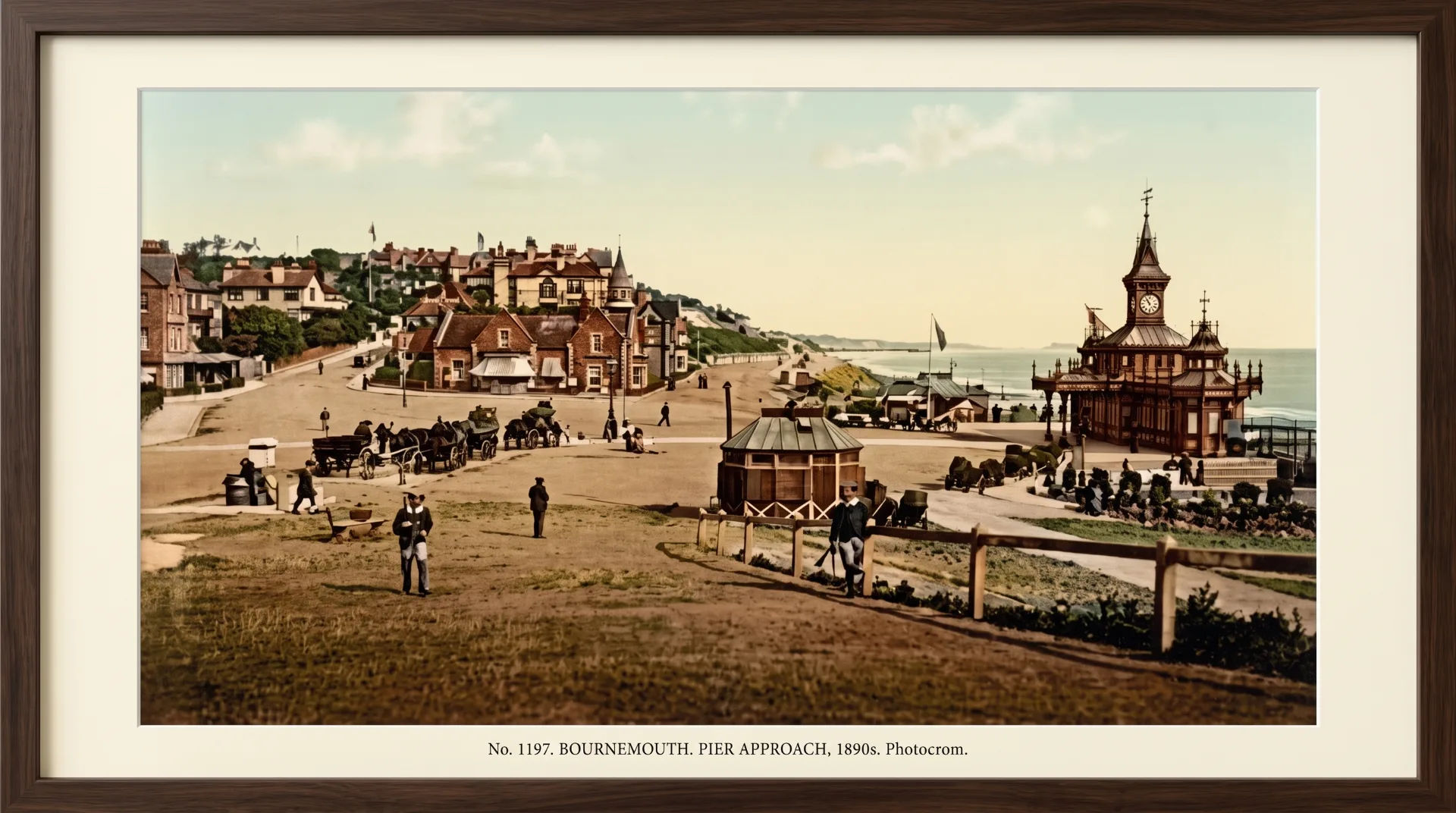
Bournemouth’s pier begins as a wooden jetty in 1855, replaced by a wooden pier in 1861, and then by an iron pier in 1880. The arrival of the railway in 1870 significantly boosts accessibility, increasing visitor numbers and accelerating urban growth. The population reaches 16,859 by 1881 and more than doubles to 37,000 by 1891.
During this period, notable buildings and attractions emerge. The Red House, built in 1877 by the Prince of Wales for Lillie Langtry, and the Mont Dore Hotel, constructed in 1885 as a health resort, are prominent examples. The Mont Dore later becomes Bournemouth’s Town Hall in 1921. The Winter Gardens and Pleasure Gardens are laid out in the 1870s, and Bournemouth Arcade opens, enhancing the town’s leisure and shopping options. These developments are milestones in the history of Bournemouth’s cultural and civic life.
Expansion of Bournemouth and Surrounding Villages in Its History
Bournemouth’s growth extends beyond its original boundaries in the late 19th century. Nearby villages are incorporated as the town expands. Boscombe and Springbourne join Bournemouth in 1876, with Boscombe Pier built in 1889 and a railway station opening there in 1897. Westbourne becomes part of Bournemouth in 1884.
To the east, Southbourne on Sea is developed by a local doctor as a rival resort but is absorbed into Bournemouth by 1901. Pokesdown, initially a small village with 838 residents in 1881, grows rapidly after gaining a railway station in 1891 and an urban district council in 1894. By 1900, Pokesdown’s population reaches 5,500 and it too becomes part of Bournemouth in 1901.
This period of expansion reflects Bournemouth’s transformation from a small village into a sizeable conurbation, with improved transport links and growing residential areas supporting the increasing population. This phase is a significant chapter in the history of Bournemouth’s urban development.
Cultural and Civic Developments in the Early 20th Century History of Bournemouth
The turn of the 20th century brings cultural institutions and civic improvements. The Bournemouth Symphony Orchestra is founded in 1893, and the first public library opens in 1895. The local newspaper, the Bournemouth Echo, begins publication in 1900.
By 1901, the population reaches 59,000, and electric trams start operating to connect different parts of the town. Bournemouth Municipal College opens in 1913, later becoming Bournemouth and Poole College. The Russell-Cotes Art Gallery & Museum is established in 1922 when Merton and Annie Russell-Cotes donate their home and art collection to the town.
Entertainment venues develop alongside cultural institutions. The Pavilion Theatre, opened in 1929, hosts touring shows, West End productions, and annual pantomimes. Bournemouth’s boundaries are extended in 1931 to include Kinson, Wallisdown, and Holdenhurst, reflecting continued urban growth. These cultural and civic milestones are important elements in the history of Bournemouth’s community life.
Bournemouth During the World Wars and Post-War Period in Its History
During the Second World War, Bournemouth serves as a refuge for evacuated children from Portsmouth and Southampton starting in 1939. Despite hopes for safety, the town experiences bombing raids that result in 219 fatalities. In 1936, Bournemouth faces a typhoid epidemic, highlighting public health challenges of the era.
Post-war, Bournemouth continues to develop as a cultural and conference centre. The Bournemouth International Centre (BIC), a major venue for concerts and exhibitions, opens in 1984. Bournemouth University is founded in 1992, evolving from a polytechnic and contributing to the town’s educational and economic profile.
In 1997, Bournemouth becomes a unitary authority, with the historic Town Hall housing Bournemouth Borough Council, including teams responsible for tourism marketing, events, and destination development. These events mark key moments in the recent history of Bournemouth’s governance and civic identity.
Modern Bournemouth and Its Economy Reflecting the History of Bournemouth
Today, Bournemouth has a population of approximately 196,455 (2021 Census). Tourism remains a key industry, supported by a variety of accommodation options, visitor attractions, bars, and restaurants. The town’s economy has diversified to include finance, insurance, and digital sectors, reflecting its status as a prosperous coastal destination.
Bournemouth’s history is visible in its architecture, public spaces, and cultural institutions. The Victorian heritage blends with modern developments, making it a town with a rich past and dynamic present. Understanding the history of Bournemouth helps appreciate its unique character and ongoing evolution.
For more on local attractions and things to do, see the Things to Do section and explore Bournemouth’s Beaches and Attractions. To plan your visit, the Visitor Information page offers practical guidance.
For further reading on the background of the town and its development, see the Wikipedia page on Bournemouth. Official information on local services and governance can be found at BCP Council. For visitor details and tourism information, Visit Dorset is a helpful resource.